

Behind the Screens is our regular practice-sharing hour when colleagues take time to reflect, demo, and exchange ideas in a relaxed space. In this session, Kirsty and Stephen demonstrated MATRICULATE, a custom-built tool designed to streamline and scale the assessment process for microcredentials.
Automating assessment workflows at scale
Kirsty Branch, Learning technologist (Assessment) and Stephen Ogden, Head of Learning Technology, demonstrated how they have responded to a new challenge arising from our microcredentials project: how to manage assessment efficiently when scale and complexity increase.
In our microcredential, learners can submit their assessment when they are ready, during a monthly submission window. Technically, this raises several issues, such as:
- Tracking how many assessments each student had completed
- Distributing marking fairly across a team
- Managing increasing numbers of courses without increasing administrative workload
While Canvas supports some of these processes, they found that many tasks required manual, repetitive steps, particularly when managing submissions and assigning markers.
As a solution to this problem, Kirsty and Stephen developed a tool which he and the team have called MATRICULATE. It’s an interface that automates the entire assessment lifecycle while working alongside existing Canvas functionality.
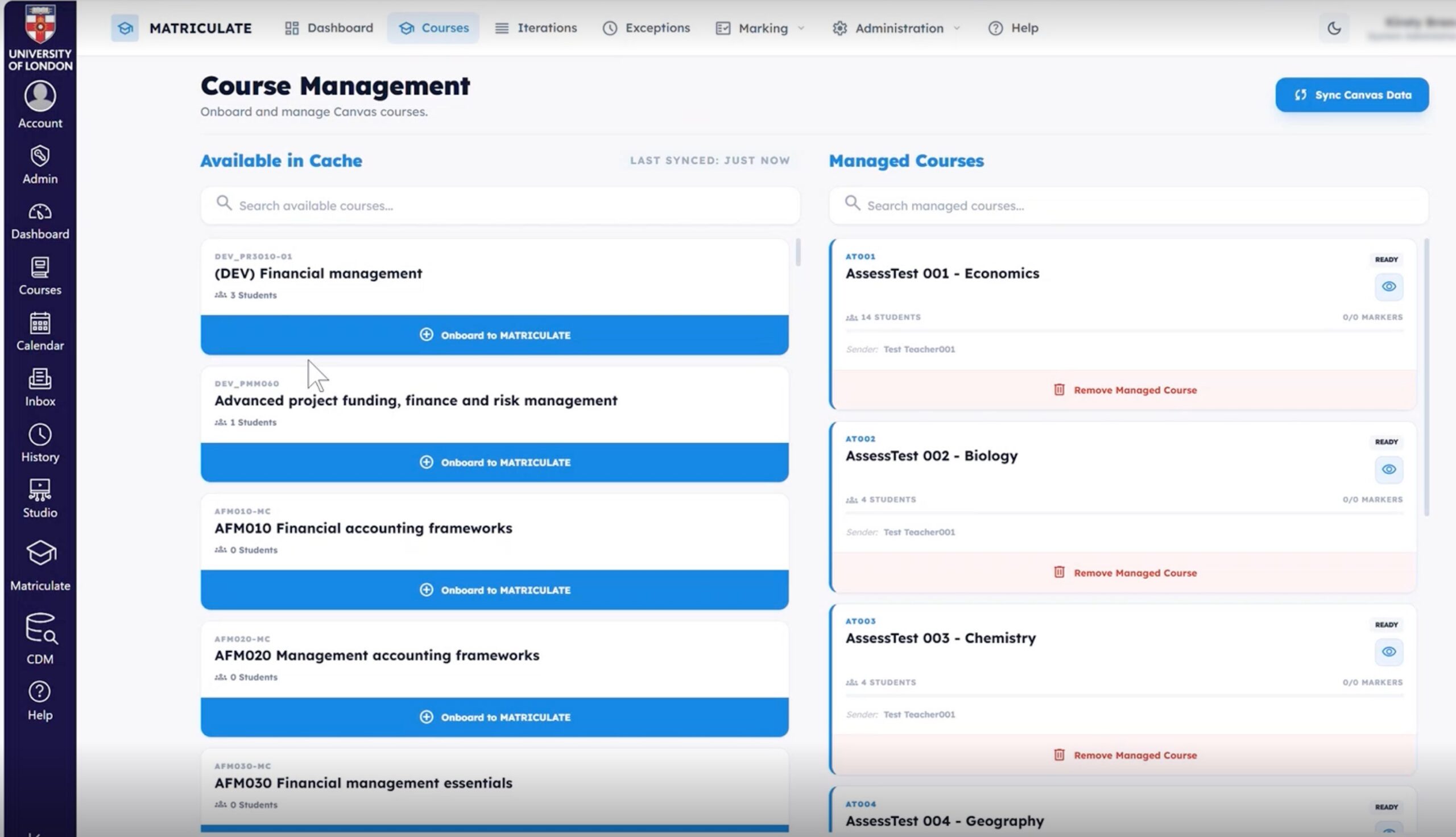
The demo walked through the key stages of the process:
- Setting up iterations to manage assessment windows
- Automatically generating assignments across multiple courses
- Allocating students to cohorts based on submission eligibility
- Collecting and applying marker capacity
- Distributing submissions into marking groups
- Tracking progress and releasing grades
- Finalising and resetting the cycle
What might normally take hours of manual work can be completed in minutes, even across large numbers of courses. The system ensures that:
- Students only see relevant submission points
- Markers receive a fair and manageable workload
- Administrative tasks are handled in bulk rather than individually
A particularly notable feature is how MATRICULATE creates dynamic marking groups within Canvas, automatically assigning students and markers while maintaining visibility and control.
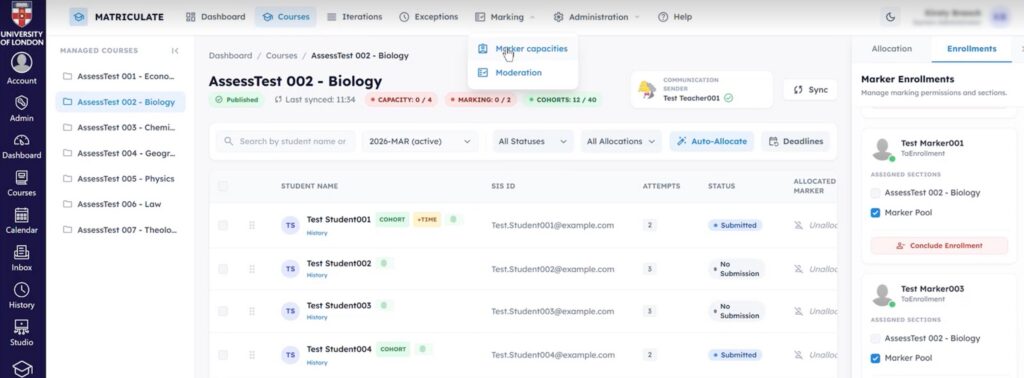
The development process itself was equally insightful. The team:
- Carefully mapped each step of the existing workflow
- Used a “vibe coding” approach to build the tool
- Developed simulation tools to test submissions and marking at scale
This iterative, hands-on approach allowed them to refine the system quickly and ensure it met real operational needs.
Discussion following the demo raised important considerations around sustainability and scalability. While the tool significantly improves efficiency, there are questions around opportunities for further development, such as self-service input for marker capacity.
Conclusion
Matriculate demonstrates what can be achieved when teams take ownership of complex processes and look for ways to improve them. By automating repetitive tasks, it frees up time for more meaningful work and enables assessment to scale without becoming unmanageable.
It also highlights an important balance: innovation often happens at the edges of institutional systems, and sharing these developments helps build a collective understanding of what’s possible—and what might come next.
Behind the Screens gives colleagues a chance to share practical, hands-on work in a low-pressure space. It fosters a culture where challenges are shared early, prototypes are celebrated, and solutions are developed collaboratively.
This blog post was developed with the assistance of generative AI tools to support transcription summarisation of the meeting. Final edits and judgement were provided by a human author.
Photo by Google DeepMind on Unsplash
