

Image credit: Yutong Liu & Digit / Digital Nomads: Digital-Based Connection / Licenced by CC-BY 4.0For our October meeting of the Digital Education Reading Group, we’re pleased to welcome back Tim Hall (Senior Manager: Product Innovation) as our facilitator. As AI becomes an increasingly important part of our courses, our practice and our wider conversations about online education, Tim will lead a discussion around the question What does it mean to be AI literate?
Beyond using AI: what does it mean to be AI literate?
In our online programmes, artificial intelligence is part of the curriculum, the design of our courses and our day-to-day work. It is tempting, and perhaps even sensible, to conclude that we need to help people become knowledgeable about this technology, and that we should probably be embedding AI literacy into our courses. But this conclusion raises a few questions. What do learners and educators need to know about these systems beyond being able to use them? And what does it mean to educate people in that understanding, rather than just teaching them how to operate tools?
It feels like we have been here before. Social media brought real benefits (okay, arguable), but we were slow to ask what it might do to people and to society. Is this a chance for us to ask those questions earlier?
“AI literacy” appears in institutional strategies, sector policy and competency frameworks, but it is often defined differently depending on where you look. It can mean prompting well and checking outputs. It can mean understanding how AI reshapes knowledge, work and power. It can be digital and information literacy under a new name. If anything, this variety shows that there are different ideas about what AI literacy is for.
What kind of AI literacy do we need?
This session is based on the Open University’s Framework for the Learning and Teaching of Critical AI Literacy Skills (Hauck, Moore and Wright, 2025). It is arranged in six domains and applies an equality, diversity, inclusion and accessibility lens throughout. It also relies on a particular understanding of literacy as a social practice:
Critial AI Literacy is…something individuals do rather than possess.
Hauck, Moore and Wright (2025)
We will think about what follows from that claim, and whether the framework’s domains and proposed skills fully reflect it.
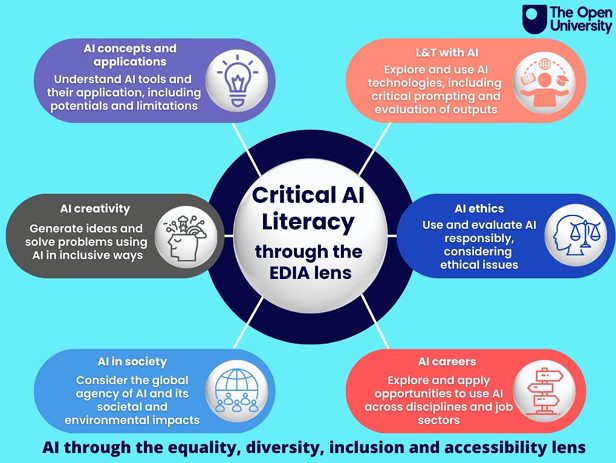
The Open University’s framework for critical AI literacyWe will read it alongside a critical review of how AI literacy is defined in the research literature. Velander, Otero and Milrad (2024) find that most definitions acknowledge AI’s ethical implications, but far fewer help learners question AI’s place in the wider world or imagine how it might be otherwise.
In her 2024 blog post, Maha Bali, from the American University in Cairo, lays out a practical model of critical AI literacy grounded in critical pedagogy and social justice. She also raises a question many frameworks avoid, which is “what if learners choose not to use AI at all?”.
Finally, a short story from 2013: Ted Chiang’s The Truth of Fact, the Truth of Feeling. It follows two narratives. In one, a journalist tests a technology that records every moment of a person’s life. In the other, a young man in a Tiv community in colonial Nigeria learns to read and write, and finds that writing changes what his community counts as truth. I really like this story as it asks what happens when a technology changes not only what we can do, but what we remember, what we trust, and what counts as knowledge. It invites us to think historically, rather than treating generative AI as an unprecedented event.
I hope this session will give us a chance to think about our own practice. Does the AI-enabled learning we design help people use AI well, question it, and make informed choices about when and whether to use it?
Reading and listening
Short on time? Skim the six domains of the OU framework. If you have an evening, read the Chiang!
Hauck, M., Moore, E. and Wright, C. (2025)
A framework for the learning and teaching of critical AI literacy skills
The Open University
Velander, J., Otero, N. and Milrad, M. (2024)
What is critical (about) AI literacy? Exploring conceptualizations present in AI literacy discourse
Springer
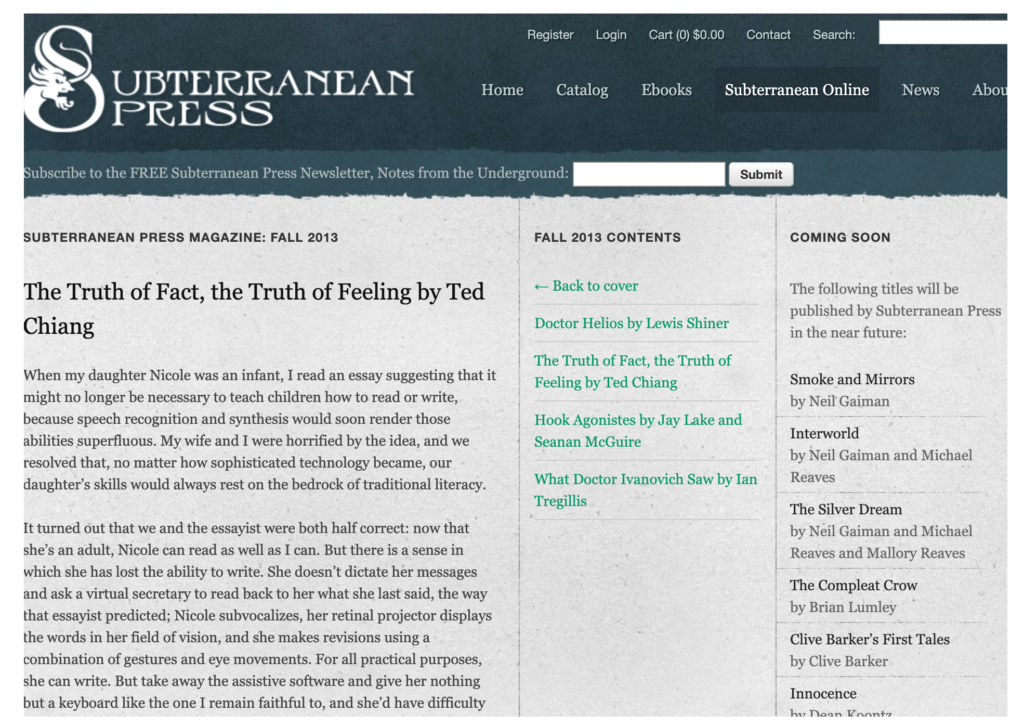
Chiang, T. (2013)
The truth of fact, the truth of feeling.
Subterranean Online
Also in Chiang’s collection Exhalation (2019).
For discussion
- Is the OU framework a description of literacy as a social practice, or a list of skills? Does it matter?
- Is prompting well a form of literacy, or just competence with a product?
- In Chiang’s story, writing changes what counts as truth. What might AI be changing about what counts as knowing?
- What would we change in a module or learning activity if we wanted to develop embedded critical AI literacy?
Tim
List of topics discussed at previous meetings
Image credit: Yutong Liu & Digit / https://betterimagesofai.org / https://creativecommons.org/licenses/by/4.0/