

Over the past few months, I’ve been building a Financial Management educational simulation for our online BSc Professional Accountancy programme. The aim of the simulation is for students to be able to apply what they learn to a realistic professional scenario. Students join a fictional company as an advisor to the board. They are then required to make challenging financial decisions at points throughout the course, and see the consequences develop over time.
As a learning designer, developing this kind of bespoke simulation would likely have required specialist development support or a third-party platform in the days before generative AI. Using ChatGPT and Codex (Open AI’s coding agent) alongside my learning design expertise allowed me to design, build and iterate it much more directly.
This post explores the process and pedagogy behind that work. I’ll share what I learnt about designing meaningful decision-based learning with generative AI and outline what others considering a similar approach might take from the experience.

Why a simulation was a good fit for Financial Management
The BSc Professional Accountancy is tailored exclusively for ACCA students, so preparing students for professional practice was an important consideration in the learning design. We developed plenty of opportunities within the Financial Management course for students to practise calculations and techniques. However, the learning outcomes extended beyond calculation. Students also needed to interpret financial information, weigh competing priorities and use it to make decisions where the best course of action was not always clear.
Simulation-based learning offers a way to do this. In a meta-analysis of 145 higher education studies, Chernikova et al. (2020) found that simulations can support the development of complex skills through practice connected to professional contexts. Faisal et al. (2022) similarly found business simulations being used to develop decision-making, problem-solving, analytical and critical-thinking skills.
For me, the key benefit was creating a space where students could apply their knowledge to interconnected, uncertain and consequential decisions, then reflect on the outcomes of their choices. The simulation therefore sits alongside and builds on other types of formative practice, giving students something distinct from practising individual techniques in isolation.
Turning the course into a continuing simulation
The simulation follows one fictional company, Senate Technologies, which students revisit at the end of each of the 16 topics in the course. Each time, they encounter decisions, events and information that draw directly on what they have been learning.
For example, the first topic introduces the financial management environment. In the game, students set priorities for the company, respond to a breaking market event and decide how to balance different stakeholder interests. Those choices then begin to shape their version of Senate Technologies.
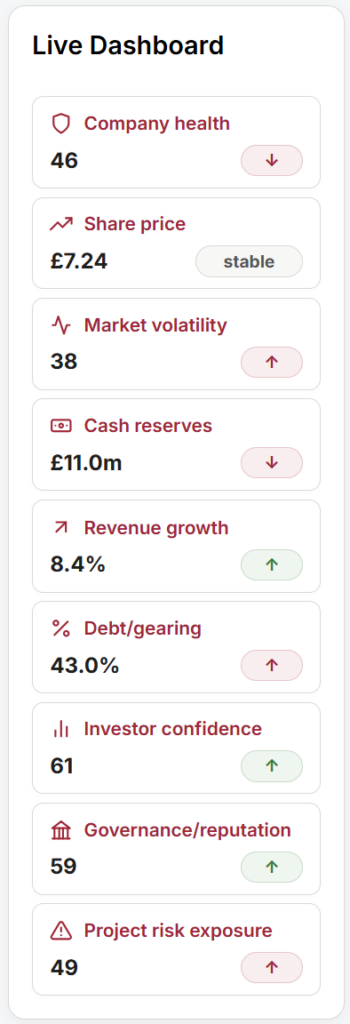
A live dashboard responds to their decisions in real time, while earlier choices can influence later events and how exposed the company is when circumstances change. By the final stages of the simulation, decisions made much earlier can affect how well the company is positioned to respond to a new crisis.
The simulation follows one fictional company, Senate Technologies, which students revisit at the end of each of the 16 topics in the course. Each time, they encounter decisions, events and information that draw directly on what they have been learning.
For example, the first topic of the module introduces the financial management environment. In the game, students set priorities for the company, respond to a breaking market event and decide how to balance different stakeholder interests. Those choices then begin to shape their version of Senate Technologies.
A live dashboard responds to their decisions, while earlier choices can influence later events and how exposed the company is when circumstances change. By the final stages of the simulation, decisions made much earlier can affect how well the company is positioned to respond to a new crisis.

More than just a branching game
The intention was not just to create a branching game in which students make a choice and move on. After each topic, students are given reflection prompts and access to a discussion forum where they can consider the reasoning behind their decisions and compare approaches with others. This reflects an important principle in simulation-based learning: experience alone does not necessarily produce learning. Crookall (2010) argues that debriefing is vital to learning from simulations, reinforcing the importance of giving students opportunities to process the decisions they have made.
A simple pattern therefore runs throughout the simulation: decision > consequence > feedback > reflection. This ensures the simulation is embedded within the wider course, rather than operating as a standalone game.
How I created the working simulation
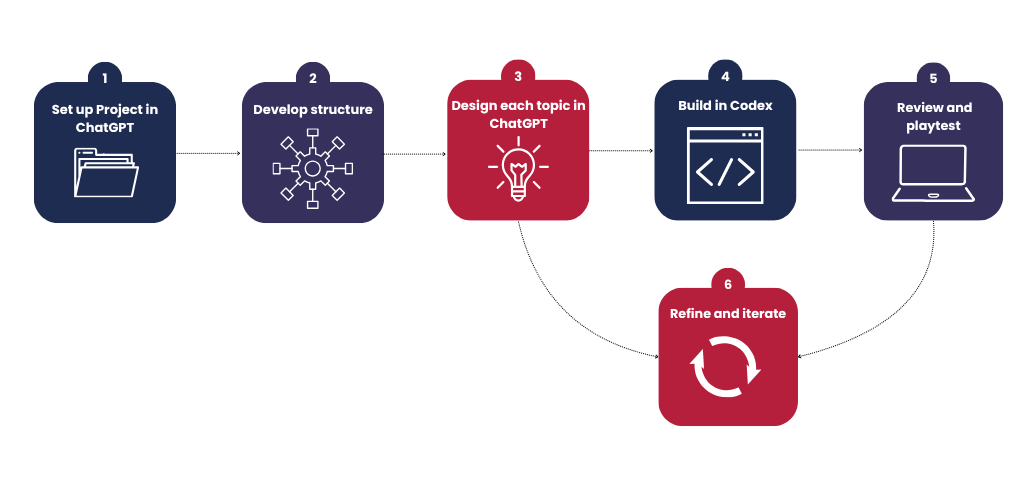
- Set up a Project in ChatGPT The process started by setting up a Project in ChatGPT and uploading the materials we had already developed for the course, including the course specification, activities, and lecture transcripts. This gave ChatGPT a strong course-specific knowledge base to work from and helped keep the simulation aligned with the learning outcomes and content students had actually encountered.
- Develop structure I then developed the overall structure. I knew I wanted students to return to the same fictional company across all 16 topics, advising on different financial matters as the course progressed, with the individual games connected to one another. I used ChatGPT to help flesh out that idea and produce a detailed prompt for Codex to build the initial framework.
- Design each topic in ChatGPT From there, I worked topic by topic. For each one, I developed the narrative, decisions and information students would receive and the consequences of their choices in ChatGPT. ChatGPT was also useful for working through the underlying simulation logic: how decisions should affect live metrics and scoring, how different choices should create different outcomes and where an earlier decision should have ramifications later in the course. Once the design was sufficiently developed, I used ChatGPT to turn it into detailed build instructions for Codex.
- Build in Codex Because Codex usage was limited by token allowances, I tried to work through as much of the pedagogical design and simulation logic as possible outside of it, reducing the amount of back and forth needed during development.
- Review and playtest Once Codex had produced something playable, I reviewed it as I would any other learning activity. Sometimes it worked well immediately. Often it exposed problems that were harder to spot in the abstract: an interaction felt repetitive, two options were too similar, a consequence was too weak or a screen simply contained too much information.
- Refine and iterate At that point I would often go back to ChatGPT to work through alternatives, refine the design and then translate the revised approach into new instructions for Codex.
What generative AI changed
Generative AI can suggest decisions, develop scoring logic or build interactions, but judging what is educationally worthwhile still requires learning-design expertise.
Using ChatGPT and Codex to ‘vibecode’ made rapid iteration much easier. I could move from an idea to something playable, review how it worked and make changes quickly without relying on anyone else.
Choi et al. (2024) similarly identify the potential of ChatGPT to support instructional design and rapid prototyping, while stressing that domain knowledge and instructional-design expertise remain necessary. That reflected my experience. Generative AI could suggest decisions, help develop scoring logic or build an interaction, but judging whether that interaction was educationally worthwhile still required learning-design expertise. My role remained the same as when I develop more standard activities: deciding what the learning experience needs to achieve and reviewing whether the activity actually does that.
Conclusion
Generative AI made it possible for me, as a learning designer, to move much more directly from an educational idea to a working, bespoke experience, and to keep refining that experience as the course developed. On a personal level, it was a rewarding creative process: it was genuinely satisfying to build a different sort of learning experience that I hope will challenge and engage students.
More broadly, using an AI coding agent has the potential to reduce some of the time, cost and technical barriers involved in developing bespoke learning experiences, making this kind of development more accessible. However, building the simulation was the easy bit; the harder questions were still pedagogical. Where are these simulations best used? Does the simulation help students to achieve the learning outcomes? As with every new experiment with generative AI, I find myself more and more convinced that the learning design expertise remains essential to the process.
The pedagogical questions are the ones that interest me the most. So, in a follow-up post, I’ll look at some of the design principles I kept returning to while building the Senate Technologies simulation.
References
Chernikova, O., Heitzmann, N., Stadler, M., Holzberger, D., Seidel, T. and Fischer, F. (2020) ‘Simulation-Based Learning in Higher Education: A Meta-Analysis’, Review of Educational Research, 90(4), pp. 499–541. https://doi.org/10.3102/0034654320933544
Choi, G.W., Kim, S.H., Lee, D. and Moon, J. (2024) ‘Utilizing Generative AI for Instructional Design: Exploring Strengths, Weaknesses, Opportunities, and Threats’, TechTrends, 68, pp. 832–844. https://doi.org/10.1007/s11528-024-00967-w
Crookall, D. (2010) ‘Serious Games, Debriefing, and Simulation/Gaming as a Discipline’, Simulation & Gaming, 41(6), pp. 898–920. https://doi.org/10.1177/1046878110390784
Faisal, N., Chadhar, M., Goriss-Hunter, A. and Stranieri, A. (2022) ‘Business Simulation Games in Higher Education: A Systematic Review of Empirical Research’, Human Behavior and Emerging Technologies. https://doi.org/10.1155/2022/1578791